

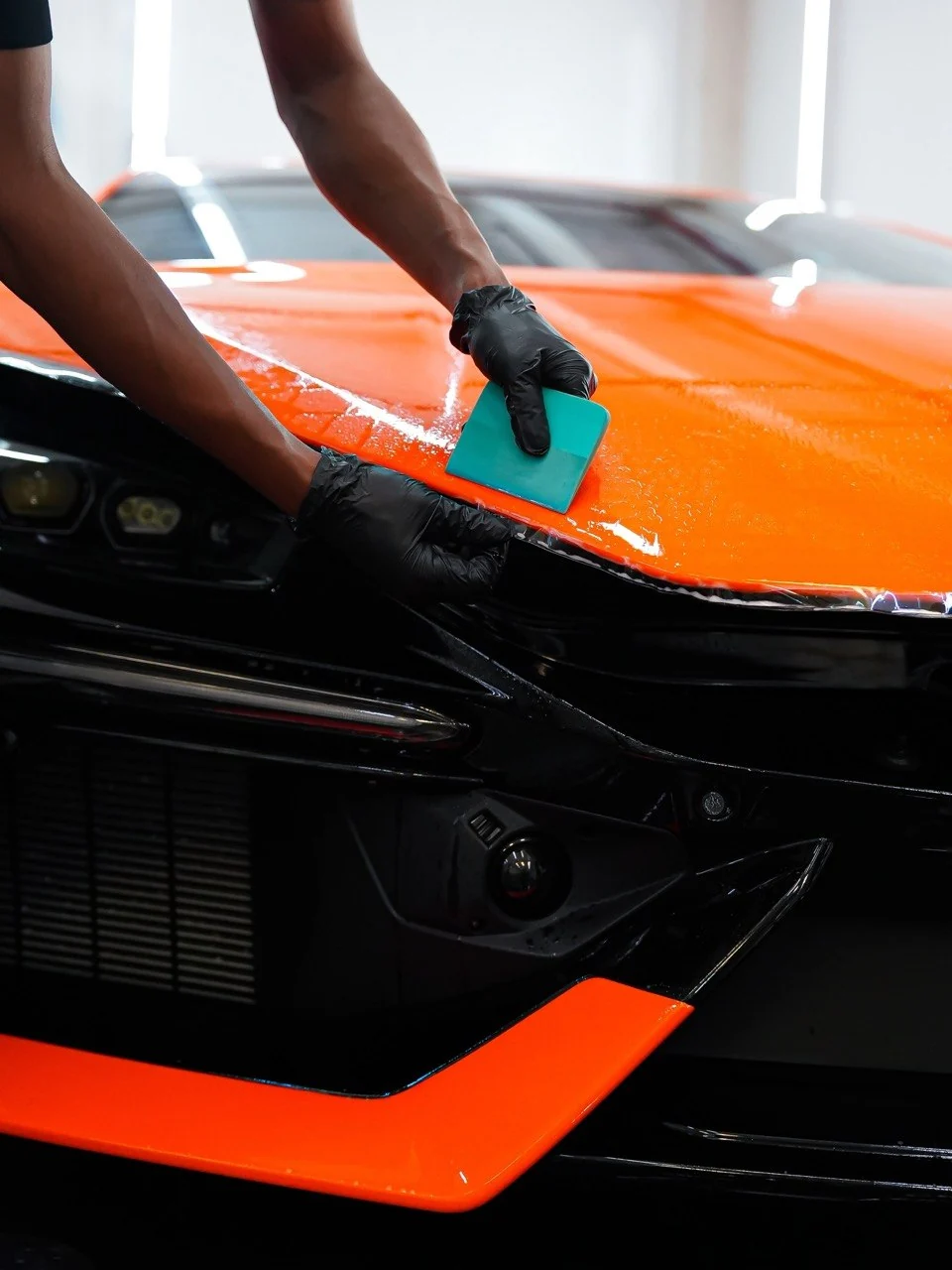
Ask two Dubai studios whether pre-cut or hand-cut paint protection film is safer and you will get two confident, opposite answers. Both are answering the wrong question.
Pre-cut and hand-cut are not two levels of safety. They are two ways of deciding where the film's edge lands. The risk to your clear coat comes from something separate: whether a blade touches the paint at any point in the job. A plotter-cut pattern avoids blade contact by default. A properly run custom install avoids it by a different route, and gets a wrapped edge in exchange. The practice that genuinely scars paint is free-hand razor trimming against a panel, and that belongs to neither method done properly.
The short version. Pre-cut and hand-cut are not two levels of safety. They are two ways of deciding where the film's edge lands. A plotter cuts the shape from a stored pattern before the film reaches the car; hand fitting establishes the boundary on the panel itself. The difference shows at the edges. A pattern is drawn slightly inside the true panel line as a safety margin, which leaves a visible film edge and a narrow strip of unprotected paint. Hand fitting exists to move that boundary out of sight. On a clear install over gloss paint, most owners never notice which one they paid for. On a gloss-to-matte conversion, it decides whether the car looks finished or looks wrapped.
Two variables, routinely confused
Every PPF install answers two separate questions, and most comparisons collapse them into one.
Where the shape comes from. Either a plotter cuts it from a vehicle-specific pattern file, or the installer fits oversized film to the panel and establishes the shape on the car.
Where the blade meets the film. Either bearing against the paint, or clear of it — the cut made above the surface, with the film held off the panel, before the edge is worked in.
Only the second question affects your clear coat. The first decides how the finished edge looks and how much of the panel actually ends up covered.
What each method is
Pre-cut, or plotter-cut
Software holds a pattern for a specific make, model, year and trim. A plotter cuts each panel's shape from roll film before it touches the car. The installer positions the piece, works it down and makes little or no cut on the vehicle. Patterns can be modified in software, and a good operator will extend a pattern where the panel allows it.
Custom, hand-fitted, or bulk
The installer lays oversized film on the panel and establishes the boundary themselves. This is the method that allows film to be carried past a panel edge and secured behind it, because the installer controls how much material is available at every edge rather than inheriting that decision from a file.
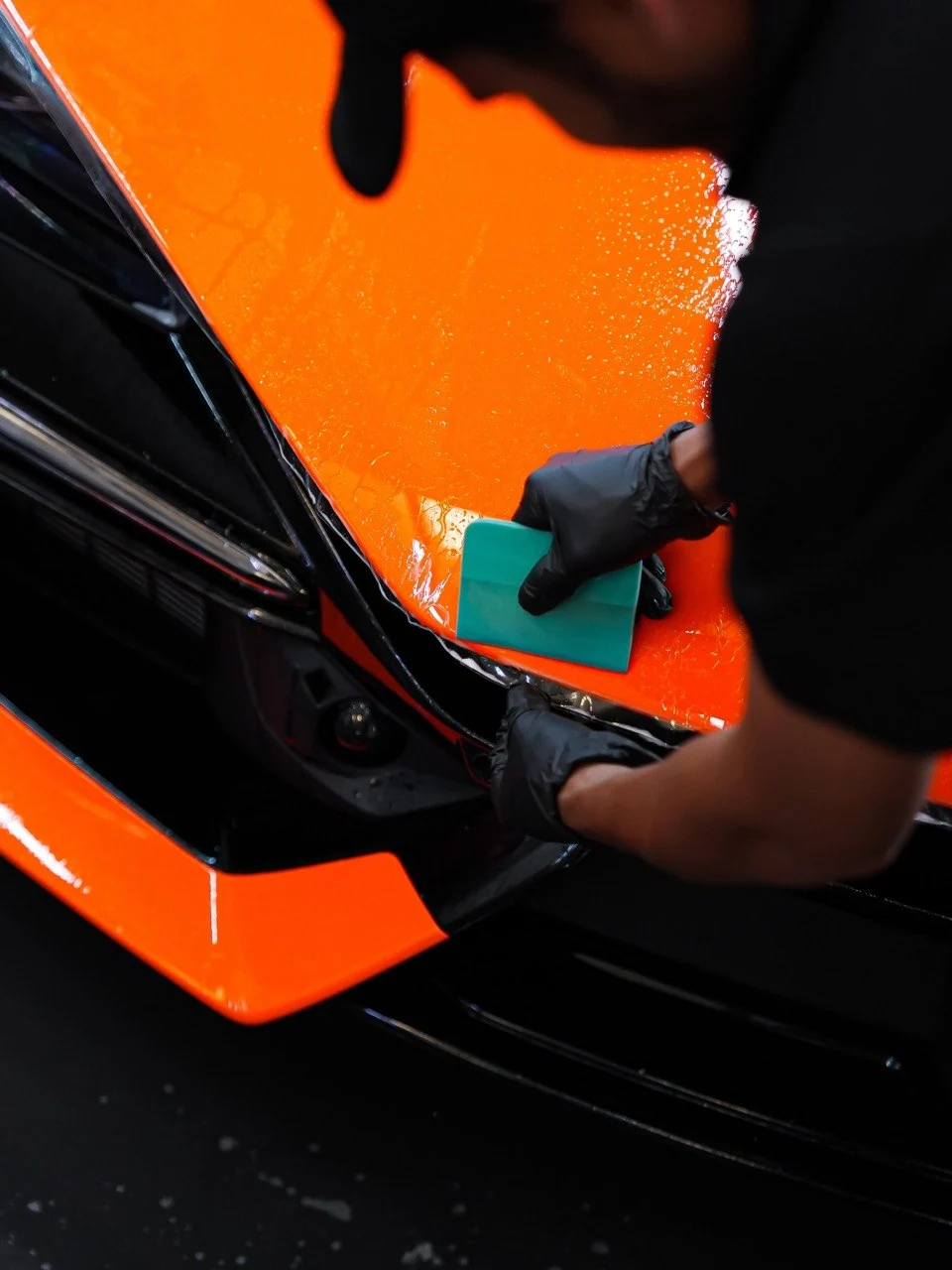
Free-hand razor trimming on paint
A blade run directly against clear coat to trim excess film. This is the actual hazard, and it deserves naming separately rather than filing under "hand-cut". Industry guidance is unambiguous: a blade that is too aggressive will score the clear coat, and the damage sits hidden beneath the film until it is removed years later. It is also entirely avoidable, which is the point.
| Pre-cut pattern | Custom, hand-fitted | Free-hand razor on paint | |
|---|---|---|---|
| Blade contact with clear coat | None by default | None, when the cut is made clear of the surface | Yes, every trim |
| Who decides where the edge lands | The pattern file | The installer, panel by panel | The installer |
| Wrapped edges achievable | Almost nowhere — a genuinely invisible termination is rarely possible | Yes, wherever the panel allows | Yes, but at paint risk |
| Consistency car to car | High | Depends on the installer | Depends on the installer |
| Typical workshop time | Shorter | Longer | Also long |
Get a bespoke PPF quote
Discuss the right coverage and finish for your car on WhatsApp.
What pre-cut costs you
The inset edge
Pattern files are drawn deliberately inside the true panel boundary. The margin exists so that normal variation in panel fit, trim gaps and installer alignment never puts a blade near paint. It is a sensible design decision and it has a consequence: the film stops short, typically by one to three millimetres, leaving a visible line and a narrow band of paint doing exactly the job the film was bought to do.
On a bonnet lip or a door edge, that band is where stone chips concentrate. It is also where wash mitts catch and where grit collects against the film's edge, which is the usual starting point for lifting.
Pattern libraries lag the market
Coverage is excellent for established European and Japanese models and thin for anything recent. The newer Chinese performance and luxury models arriving in Dubai in volume are the clearest case: panel geometry, trim fixings and badge mounting are often not covered properly by any library yet. An installer working from the closest available file is approximating, and approximation at a panel edge is visible.
Patterns assume a factory car
A pattern describes the car as it left the plant. It does not know about the aftermarket front lip, the replaced bumper, the resprayed wing or the panel that sits two millimetres proud after a repair. Hand fitting absorbs that. A file cannot.
How the cut is actually made
This is the part the "hand-cut is risky" argument leaves out. Keeping a blade off paint is a matter of method, not luck.
The shape is worked out in advance rather than discovered on the panel. Where film still has to be cut during fitting, the cut is made clear of the bodywork: the blade runs in the air, above the surface, with a deliberate gap between film and panel, so it never bears on the clear coat. The cut is also left long on purpose. A small margin of film is allowed to extend past the panel line, and that margin is then worked in behind the edge.
That last step is the whole point. The surplus that a pattern never gives you is what puts the film's termination out of sight. Done this way, a custom install carries the same blade-contact risk as a plotter-cut job, which is none, and still controls where the edge lands.
The case that settles it: changing the finish
Everything above is a question of degree until the film changes how the car looks.
Put clear film on gloss paint and an inset edge is a faint line with the same finish on both sides of it. From a metre away, nobody sees it. Put satin or matte film on a gloss car and that same edge becomes the boundary between two different finishes. Satin scatters light; the paint beside it reflects it. Under Dubai sun or workshop lighting, the eye finds that line immediately, and it runs the length of every panel the pattern stopped short on.
Corners are worse than edges. A panel corner curves in two directions at once, which is where a pattern leaves the most paint showing: a bright triangle at each mirror cap, bumper corner and headlight surround. Each is two or three millimetres. Together they are the difference between a car that looks finished and one that looks wrapped.
So the claim that pre-cut is safest for matte and rare finishes gets it backwards. It is safest for the blade, which is a solved problem either way. For the result, an inset edge is the one outcome a finish conversion cannot tolerate.
How Modcare approaches it
We fit film by hand, panel by panel. On a finish conversion we do not terminate film on the visible face at all; it is carried around the lip and worked in behind it. That is slower than running a pattern, and it is most of the difference between our quote and a cheaper one.
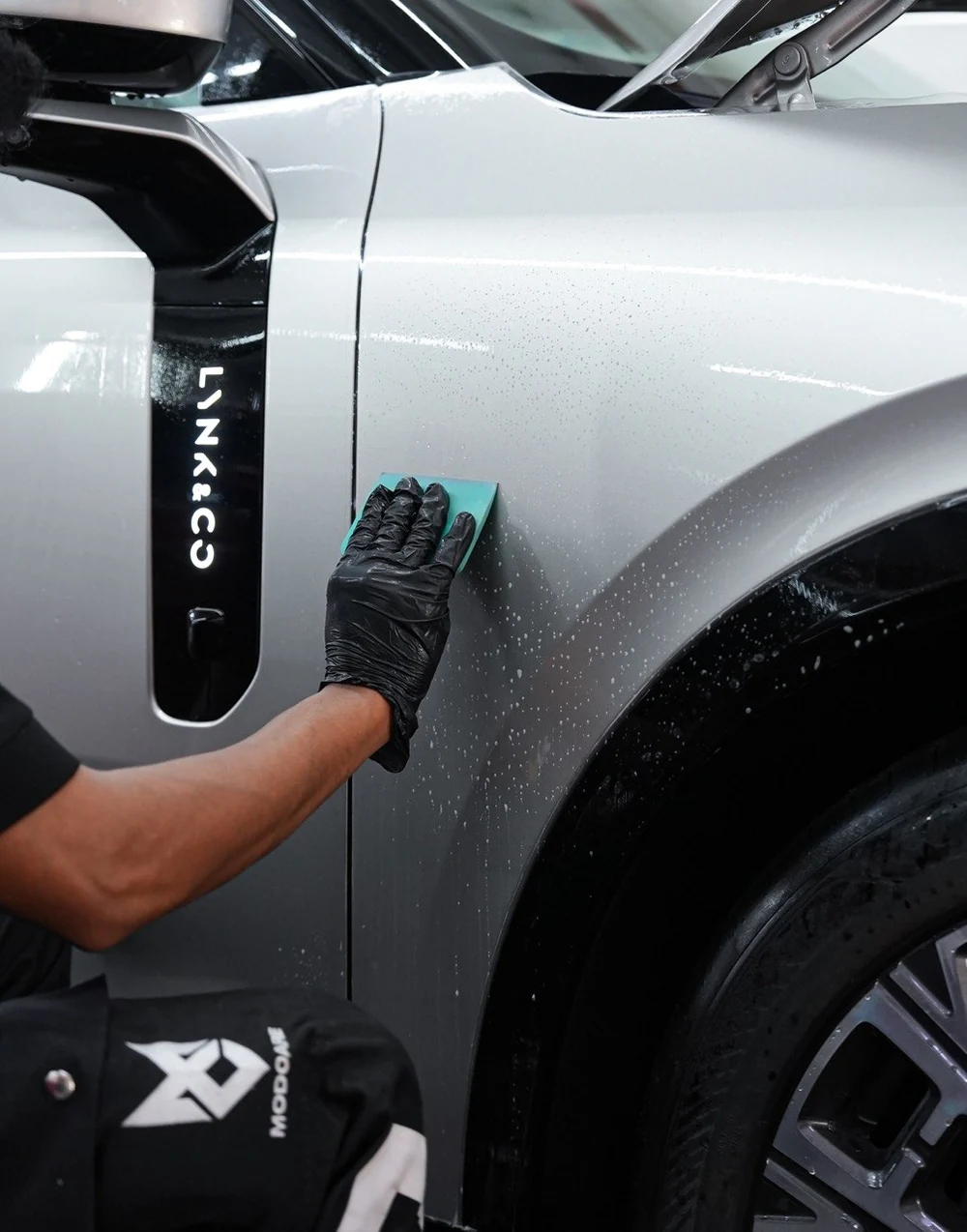
We have completed more than 500 cars in matte polyurethane and work with satin and matte finishes weekly, including Range Rover, Porsche, Rolls-Royce, BMW, McLaren, Mercedes-Benz and Ferrari, alongside newer Chinese models such as Li Auto and Lynk & Co where no pattern library is reliable yet. Every install carries a 10-year film warranty and a lifetime warranty on our workmanship, which on a job defined by its edges is the clause worth reading twice.
We will also tell you when pre-cut is the sensible choice. If you want clear film on a common model and an invisible termination is not your priority, there is no reason to pay for the slower method.
Share your car details and speak to the Modcare team on WhatsApp.
Frequently asked questions
Is hand-cut PPF dangerous for my paint?
Not inherently. The danger is a blade cutting against clear coat, which is a specific bad practice rather than a feature of hand fitting. When the cut is made clear of the surface, a hand-fitted install puts no blade on paint at any point.
Does pre-cut PPF leave visible edges?
Usually a faint one. Pattern files are drawn slightly inside the true panel edge as a safety margin, so the film stops one to three millimetres short. At first most owners do not notice it. Over time that exposed strip collects road dirt along its whole length, and a line you could not see at handover becomes one you cannot stop seeing.
Which PPF method is better for a matte or satin conversion?
Hand fitting with wrapped edges. An inset edge on a finish conversion leaves a strip of the original gloss paint beside satin film, and that boundary is visible from standing distance. We cover why matte is less forgiving than gloss in our guide to matte PPF.
Can a pre-cut PPF pattern wrap edges?
Sometimes. A pattern can be extended in software where the panel has enough spare material and there is access to secure film behind the lip. Where there is not, the edge terminates on the visible face.
Is hand-cut PPF more expensive?
Generally yes. It takes longer and uses more film, so the difference is labour rather than material quality. It is also the method the trade treats as the benchmark, because an invisible termination cannot be reached any other way.
How do I tell whether my PPF edges were wrapped?
Run a fingernail along a bonnet lip or door edge. A wrapped edge continues around and you feel film on both sides. A cut edge gives you a step on the visible face.
Does a PPF pattern exist for every car?
No. Coverage is strong for established European and Japanese models and patchy for recent arrivals, including many newer Chinese models. Even where a pattern does exist it is often not adaptive enough for the actual car in front of you, so hand fitting remains the only reliable way to get a properly terminated edge.
Ready to protect your car?
Ask about bespoke PPF, coverage and pricing.